Core Scientific plans to shut down Bitcoin mining despite Q3 revenue hitting $233M
Reading sizeRead report ↓
Loading image
Bitcoin mining contributed just 7.5% of its Q3 revenue as the company accelerated its transition towards AI and HPC infrastructure.
Core Scientific, once the largest Bitcoin [BTC] miner, has released its Q3 2026 report, but at the same time it has also announced its plans to completely exit Bitcoin mining by the end of 2026.
During its Q3 2026 earnings call, Chief Financial Officer Jim Nygaard said the company expects to complete the mining wind-down in the fourth quarter and enter 2027 as a high-density colocation provider.
This decision came as the firm’s Q3 results were primarily driven by the expansion of its high-density colocation (HDC) business, which supports AI and high-performance computing (HPC) workloads.

Source: Core Scientific
Core Scientific’s AI shift
Remarking on the same, CEO Adam Sullivan said,
We are nearing full delivery under our first colocation agreement while construction under our second is underway across five campuses.
According to the reports, the company’s colocation revenue surged nearly 60% quarter-over-quarter to $215.4 million, compared to $136.7 million in Q2 2026 and $15 million in Q3 2025.
In fact, its total revenue also increased to $232.9 million, up from $164.2 million in the previous quarter and $81.1 million a year earlier.
As of the 30th of September, Core Scientific was billing for 485 megawatts (MW) of capacity, up from 395 MW in the previous quarter, representing more than $700 million in average annualized colocation revenue.
Core Scientific’s Q3 2026 results
That said, the company also reported net income of $1.178 billion, compared to a net loss of $1.15 billion in Q2 2026 and $144 million in Q3 2025.
Meanwhile, adjusted EBITDA more than tripled quarter-over-quarter to $133.6 million, with its margin expanding to 57% from 25% in the previous quarter. Core Scientific’s gross profit also climbed to $123.3 million, compared to $70 million in Q2.
However, on the mining side, self-mining revenue declined to $12.3 million from $21.5 million in the previous quarter, while hosted mining revenue stood at $5.17 million. At the same time, revenue from hosting equipment for other Bitcoin miners also declined to $5.2 million from $8.7 million.
How it all began?
For those unaware, Core Scientific began its AI infrastructure transition in 2024 through hosting agreements with CoreWeave, covering 590 MW of capacity, of which 485 MW was billable by September 2026. However, the transition also comes with challenges.
Core Scientific recorded $266.5 million in mining-related asset impairments in Q1 2026 amid weaker Bitcoin prices, low mining profitability, and declining equipment values. It also recorded a $41.9 million loss after terminating mining equipment agreements with Block and Proto in Q2.
That said, Core Scientific is not the only one, as, according to AMBCrypto’s recent report, Bitcoin miners are increasingly selling BTC to fund operations while shifting their infrastructure towards AI and HPC.
Miner’s November performance analysis
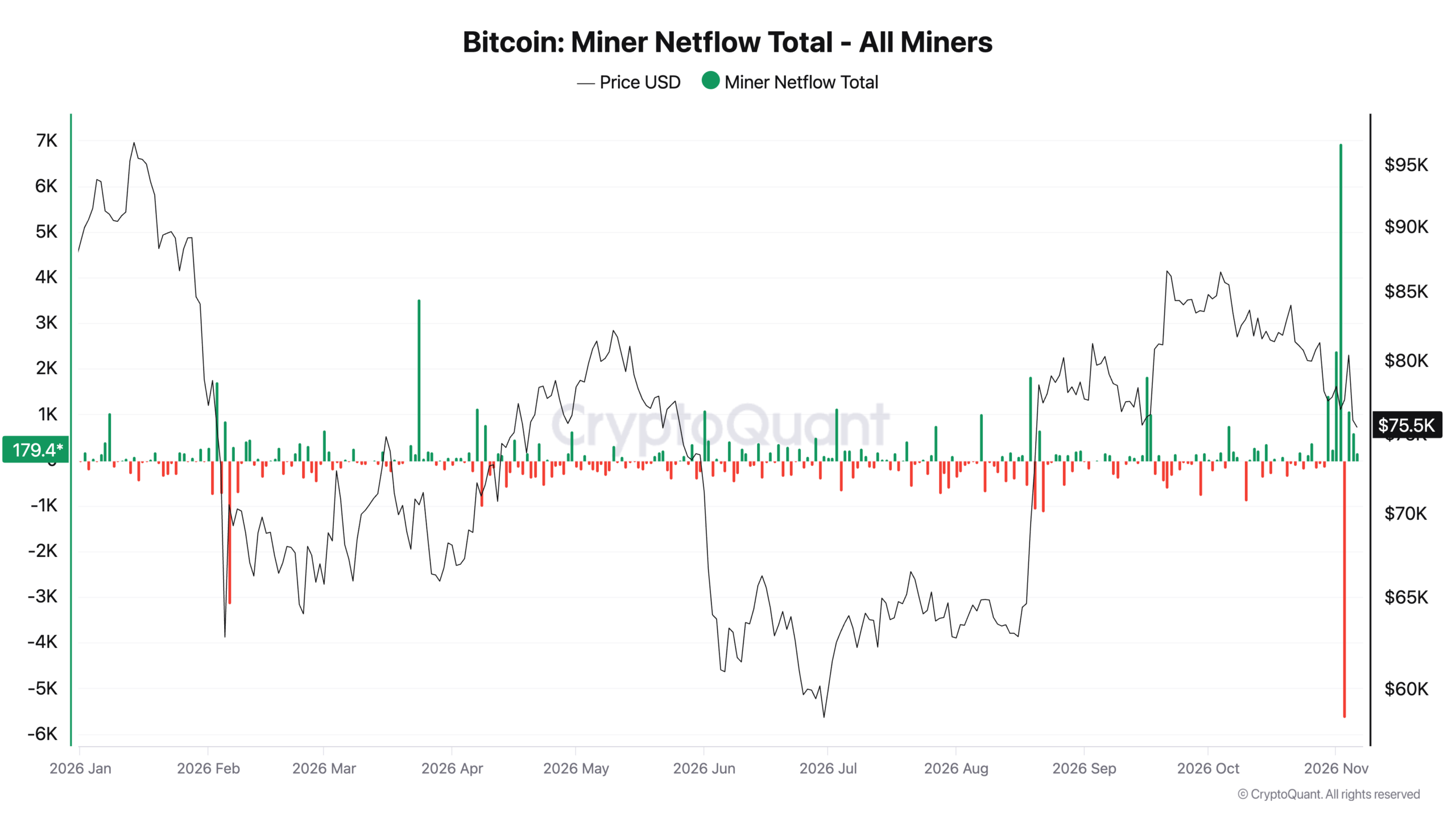
This comes as miners swung from a huge inflow spike of about +7K BTC in early 2026 to an outflow of about -5.7K BTC in early November, while the price slid from around $95K to $75.5K.
Source: CryptoQuant
However, the latest netflow has settled back to a small positive reading of about 179.4 BTC, which suggests the miner selling pressure has cooled.
Final Summary
• Q3 results were primarily driven by the expansion of its high-density colocation (HDC) business.
• Core Scientific began its AI infrastructure transition in 2024 through hosting agreements with CoreWeave.