Bitcoin price slips below $77K – Why post-election BTC crash fears persist
英文原文查看譯文
閱讀字級閱讀正文 ↓
載入圖片中
Bitcoin faces mounting crash fears as the Democratic sweep, weak spot demand, and falling BTC dominance weigh on market sentiment.
The voters have spoken. Now, the focus shifts to how investors react.
The chances of Democrats winning have already increased to 99%, and today’s outcome has seen them sweep both houses of Congress (Senate and House of Representatives). The question now is whether this shift brings some certainty to the market and allows Bitcoin to recover, or will it add another layer of volatility.
According to the latest Santiment data, Bitcoin retail sentiment has become increasingly bearish after the election results. The chart below shows that there are now only 0.51 bullish comments for every bearish comment. With many traders viewing the Republicans as more crypto-friendly, the Democratic sweep has added another layer of uncertainty to an already weak market structure.
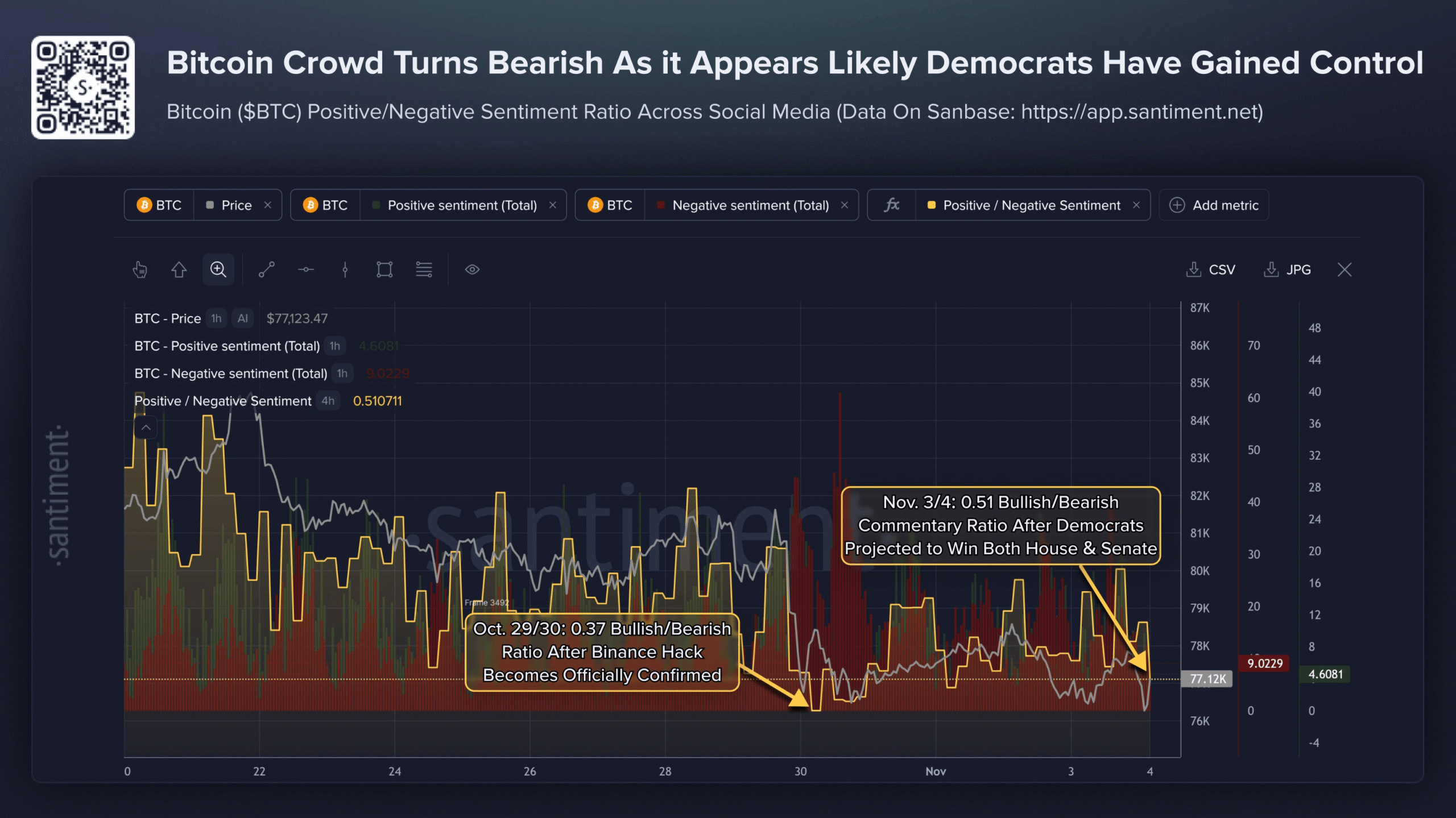
Source: Santiment
Notably, this uncertainty is now showing up across both on-chain and technical indicators.
According to CryptoQuant, Bitcoin’s bounce from recent lows appears to be slowing, with low spot demand and prolonged liquidations taking Bitcoin towards $76,800. Put simply, there is some spot buying, but it isn’t strong enough to offset the selling and liquidation from the futures market. Meanwhile, BTC dominance has faced its third rejection near the 61% range, failing to break higher. This signals fading relative strength.
Together, Bitcoin [BTC] slipping below $77k, weak on-chain momentum, and increasingly bearish retail sentiment are creating a very fragile market structure as investors digest the Democratic sweep. Therefore, is the recent rally in the Bitcoin Fear and Greed Index simply a case of the bears taking a break before sentiment falls into “extreme” fear as the Bitcoin crash narrative takes hold?
Bitcoin faces a key test as political FUD meets weak market demand
Bitcoin’s Fear and Greed Index dropped to 26 for the first time in three months.
There is no doubt that the FUD surrounding elections affected sentiment, but since the election has occurred, the index has recovered over 30%. This shows that due to the Democratic sweep, there is less political uncertainty in the market, which has led to a short-term recovery in sentiment. However, on-chain and technical indicators have yet to show the same recovery.
According to AMBCrypto, this gap between sentiment and market momentum could be important. As noted by one analyst, Bitcoin has historically faced sell-offs after elections, raising the possibility of a 30% correction if the pattern repeats. For now, improving sentiment has kept Bitcoin from sliding into extreme fear; however, clear signs of accumulation are still missing.
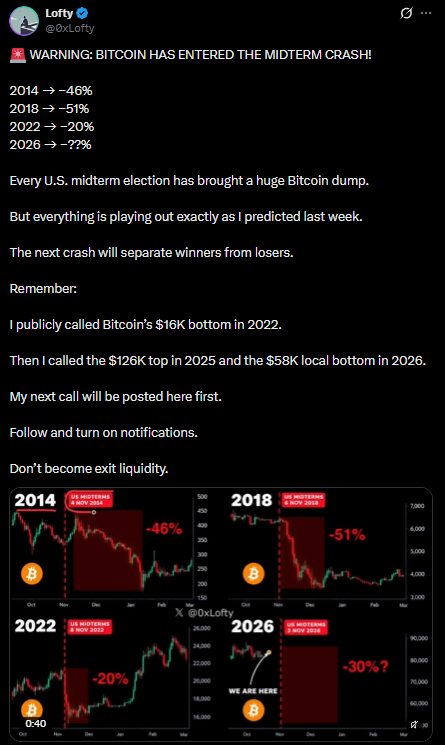
Source: X
This leaves a clear divergence between investor confidence and underlying market demand.
Unless this gap starts to narrow, the latest rebound in Bitcoin’s Fear and Greed Index may just be a short-term bounce after the elections. So, while the Democratic sweep may have taken away some of the political uncertainty, it has yet to change Bitcoin’s underlying market structure.
In this context, another midterm-driven sell-off cannot be ruled out.
Final Summary
• Bitcoin’s weak demand, falling dominance, and bearish retail sentiment point to continued market pressure despite the recent sentiment recovery.
• The Fear and Greed Index has bounced over 30%, but buying strength remains weak, leaving room for another Bitcoin sell-off.